Zone 2 rowing: how to find your zone and stay in it
Zone 2 is steady, easy-but-purposeful exercise: hard enough to breathe more deeply, easy enough to hold a conversation. It's usually given as about 60 to 70% of your maximum heart rate. People row in Zone 2 to build an aerobic base, the endurance that every other kind of training sits on, without the fatigue of hard sessions.
The rowing machine suits it well: it's low impact, works most of your body, and makes a steady effort easy to hold for a long time.
What is Zone 2, exactly?
Zone 2 is the second of five heart-rate zones, from very easy (Zone 1) to all-out (Zone 5). Concept2's heart-rate guide uses the common version, where each zone is 10% of your maximum heart rate and Zone 2 is 60 to 70%.
Sport scientists define it a little differently. A 2025 survey of experts agreed that Zone 2 sits just below your first lactate or ventilatory threshold, where your breathing first picks up noticeably, while noting there's no single agreed definition. In practice both land in the same place: a pace you could keep up for a long time while still talking.
How do you work out your heart-rate zones?
Start from an estimate of your maximum heart rate, then adjust it with what you see in training. The common methods:
- 220 minus your age. The best-known formula. For a 40-year-old it gives a maximum of 180, so Zone 2 is 108 to 126 bpm. It's easy, but it was never based on careful research, and for an individual it's typically out by 7 to 11 beats per minute, and sometimes more.
- 208 minus 0.7 × your age. A later formula from a large review, which fits older adults better. For the same 40-year-old it gives 180 as well, but at 60 it gives 166 rather than 160.
- Heart-rate reserve. Your resting rate plus a percentage of the gap between resting and maximum. It's more personal, but still relies on knowing your maximum.
- The talk test. No numbers needed. Row at a steady effort and try to speak a few full sentences. If you can, comfortably, you're at or below Zone 2. If you have to stop for breath mid-sentence, you're above it. Studies have found the point where talking gets hard lines up well with that first threshold.
Treat any formula as a starting point. Concept2 suggests the same: once you record a higher heart rate than the formula's maximum in a hard effort, use that instead, and move your zones up with it. Some medicines, such as beta blockers, lower your heart rate, so if you take one, or have a heart condition, check with your doctor before using these numbers.
What does Zone 2 feel like on a rowing machine?
It feels easier than you expect, especially at first. You should be breathing more deeply but steadily, able to talk, and feel you could keep going for much longer. Many people find that true Zone 2 means rowing slower than they'd like.
- Stroke rate. Keep it low and relaxed. Concept2 describes 24 to 28 strokes per minute as comfortable for steady rowing, and many training plans row long steady pieces lower, around 18 to 22, with longer, smoother strokes. Use whichever lets you hold the zone with good technique.
- Pace. Let your heart rate set it. Many plans put steady rowing around 15 to 25 seconds per 500 m slower than 2k pace, but if your heart rate says slow down, slow down. Our 2k pacing guide explains splits if you're new to them.
- Damper. Use a moderate setting. On a Concept2, around 3 to 5 suits most people. A heavy setting makes each stroke harder and pushes your heart rate up.
Why does your heart rate creep up during a long row?
It's called cardiac drift, and it's normal. Over a long steady session your body heats up and you lose fluid through sweat. Your heart pumps a little less blood with each beat, so it beats faster to make up for it, even though your effort hasn't changed. Researchers have described this happening after 10 to 20 minutes of exercise, and it's bigger when you're dehydrated or hot.
So let your pace drop a little in the second half to stay in the zone: that's the point of training by heart rate. Drink before and during longer rows, and point a fan at the rower. Over weeks, as your aerobic base improves, the same pace takes a lower heart rate and drifts less.
How should you start Zone 2 rowing?
Start with two or three sessions a week of 20 to 30 minutes, then build the time slowly:
- Weeks 1 and 2: two or three rows of 20 to 30 minutes, all in Zone 2. Spend a few minutes warming up below it.
- Weeks 3 to 6: add about five minutes to each session each week, until one or two of them reach 40 to 45 minutes.
- After that: one longer row of 45 to 60 minutes a week, plus your other sessions. If you also do intervals or a 2k test, keep those hard and keep the rest genuinely easy.
The most common mistake is drifting into Zone 3 because Zone 2 feels too easy. That's harder work for less of the benefit you're after. If in doubt, go easier.
Should you use a chest strap or an Apple Watch?
A chest strap is the more accurate choice for rowing, but an Apple Watch is fine for most Zone 2 work if you wear it well. In a study comparing heart-rate monitors with an ECG, the chest strap matched best, Apple Watch came next, and every wrist device struggled on a machine that moves your arms. Gripping the handle and bending your wrist on every stroke can break the watch's contact with your skin.
- With a watch: wear it snugly, a finger-width higher up your arm, above the wrist bone, and keep your wrist flat on the handle. Apple's accuracy tips also suggest tightening the band for a workout.
- With a strap: pair it to the rower's monitor (on a PM5, from the monitor's own menu) and apps that read the monitor get your heart rate too.
How Streaks Strokes helps you stay in Zone 2
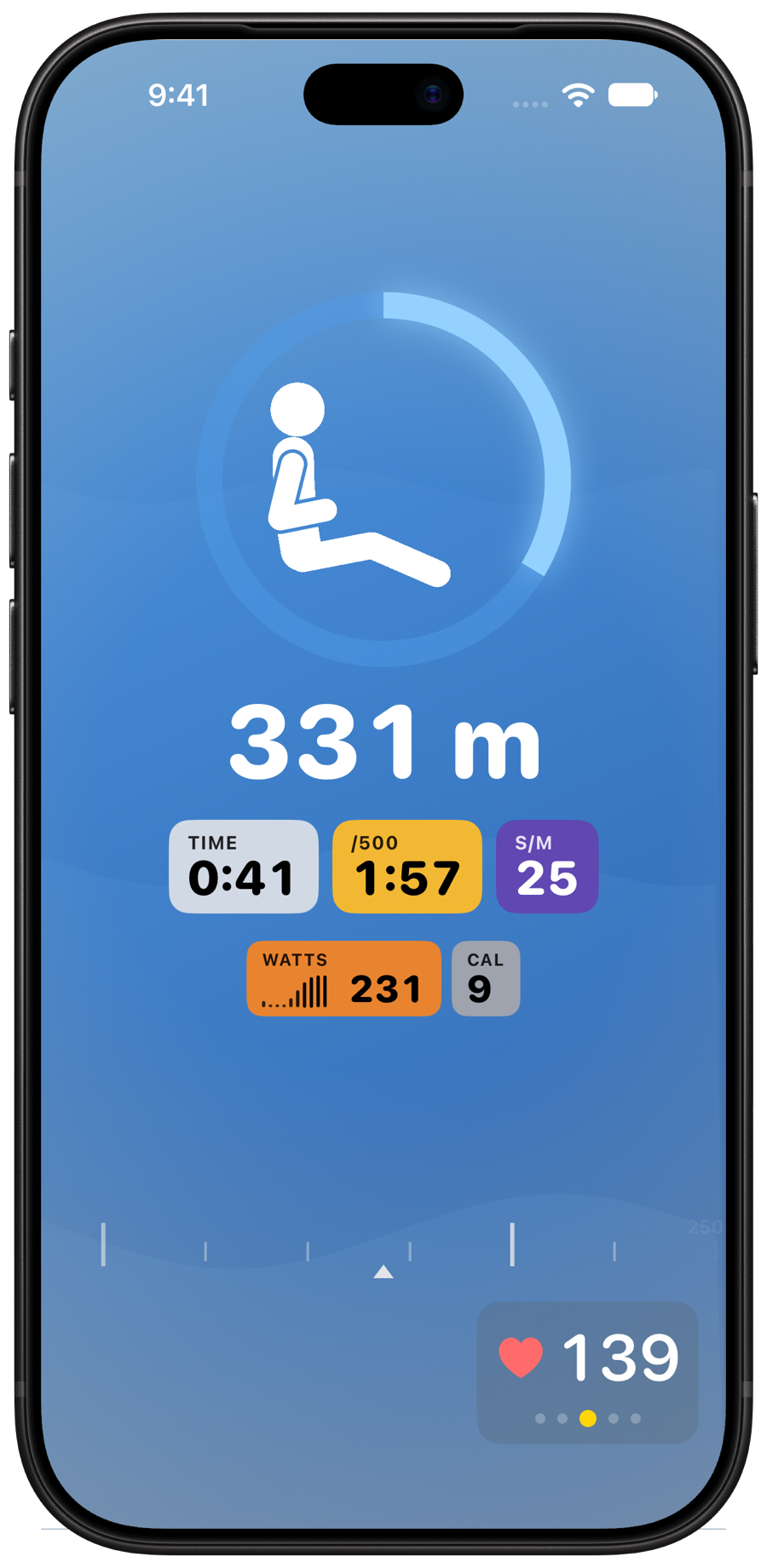
Streaks Strokes shows your heart rate as a big number in the corner of every workout, with five dots under it. The dot for your current zone lights up in that zone's colour (Zone 2 is green) and leans towards the next dot as you get close to its edge, so you can see you're drifting before you cross. Heart rate comes from your Apple Watch, or from a strap paired to your PM5.
When you finish, Workout Complete shows your Time in Zone: the minutes and percentage you spent in each zone. For Zone 2 sessions, two things are worth knowing:
- Set your own zones. In Settings → Heart Rate Zones, choose Custom and drag the edges to match your own numbers from the methods above. We recommend this over the Automatic zones, which use standard defaults (Zone 2 is 114 to 132 bpm) that may not suit you.
- Time in Zone workouts. In The Sweet Spot pack, a Time in Zone workout has one rule: the clock only counts while you're in the zone. Set it to Zone 2 and, say, 30 minutes, and the countdown pauses and dims whenever your heart rate leaves Zone 2. You're done when you've banked 30 minutes in the zone, however long that takes.
Live heart-rate zones on every row, Time in Zone when you finish, and workouts where the clock only counts while you hold Zone 2.

Questions
How long should a Zone 2 row be?
At least 20 minutes, and longer as you get used to it. Most of the benefit comes from regular time in the zone, so two or three rows of 30 to 60 minutes a week is a good target. Start shorter and build up.
Can I do Zone 2 without a heart-rate monitor?
Yes. Use the talk test: row at an effort where you can still speak in full sentences without stopping for breath. If talking gets hard, ease off. A monitor makes it easier to stay consistent, but it isn't essential.
Should I use my Apple Watch's heart-rate zones?
They're a reasonable starting point. Apple works them out from your health data, including your age, so they're still an estimate. If the talk test or your hard efforts disagree with them, set them by hand on the watch in Settings → Workout → Heart Rate Zones → Manual.
More guides
- Can you track a rowing machine with an Apple Watch?
- How to pace a 2k rowing test (and what a good 500 m split is)
- Does rowing close your Apple Watch rings?
- How to connect a Concept2 PM5 to your iPhone and Apple Health
Questions about the app? See the Streaks Strokes FAQ.
A rowing app for iPhone and Apple Watch that connects to your Concept2 PM5. Free to download, no subscription.